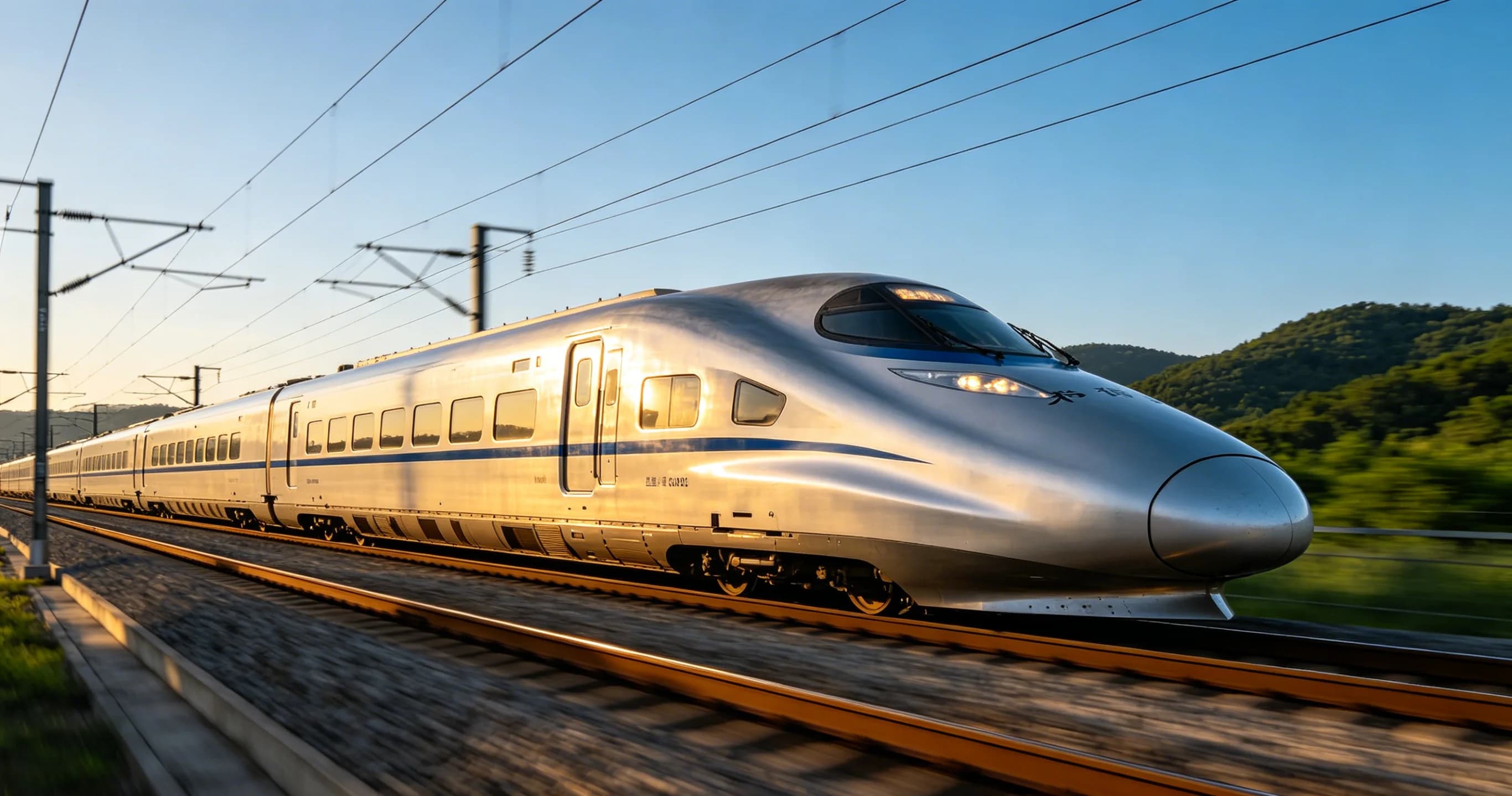

For international tourists visiting China for the first time, China's high-speed rail is more than just a means of transportation—it's like a moving window. Within hours, you can travel from Beijing to Shanghai, from the ancient city walls of Xi'an to the giant panda base in Chengdu. Compared to airplanes, high-speed rail stations are usually closer to the city center, the journeys are more stable, and it's more integrated into the daily lives of Chinese people.
This guide is for you—from buying tickets to exiting the station, from choosing seats to transferring, every step is designed from your perspective to help you avoid information gaps and common pitfalls.
Why you should absolutely experience China's high-speed rail at least once?
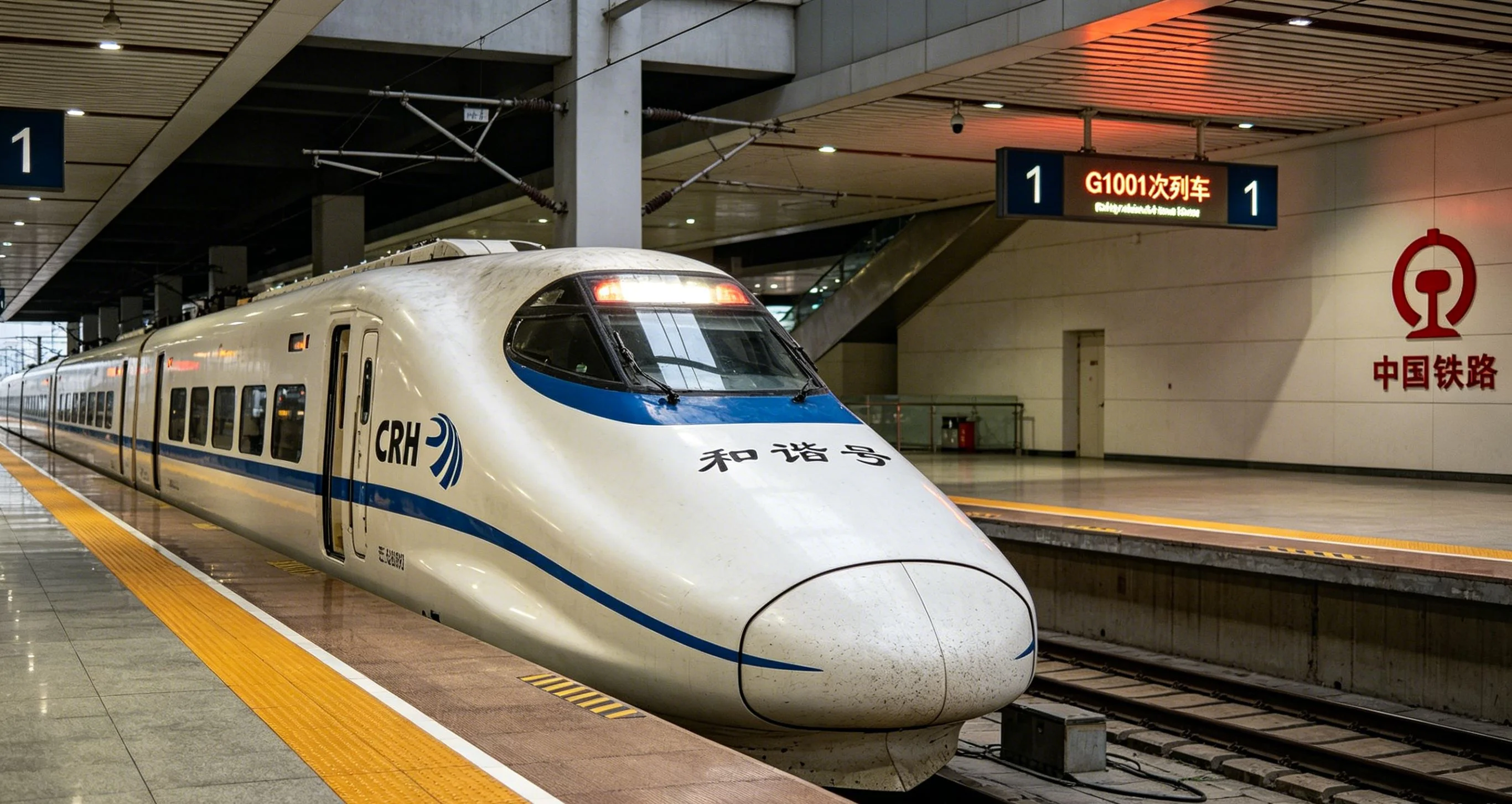
China's high-speed rail is more than just "fast." It's a way to observe the real China.
City center to city center: High-speed rail stations are usually much closer to the city center than airports, making it easy to take the subway or taxi after exiting the station.
Frequent service: Popular routes (such as Beijing-Shanghai) have dozens of trains a day, so you're not bound by flight schedules.
Extremely punctual: Cancellations due to weather are rare, making it ideal for meticulously planned itineraries.
Local experience: You'll sit alongside business travelers, families, and university students, witnessing authentic daily life in China.
Connecting multiple cities: Beijing, Xi'an, Chengdu, Guilin, Hangzhou, Suzhou… high-speed rail seamlessly connects multiple cities into a single route.
If you plan to visit 2-4 cities at once, high-speed rail is much more convenient than flying.
The first thing you must understand before buying a ticket: the trap of station names
Many cities in China have multiple train stations. This is a common mistake tourists make.
Here are a few examples:
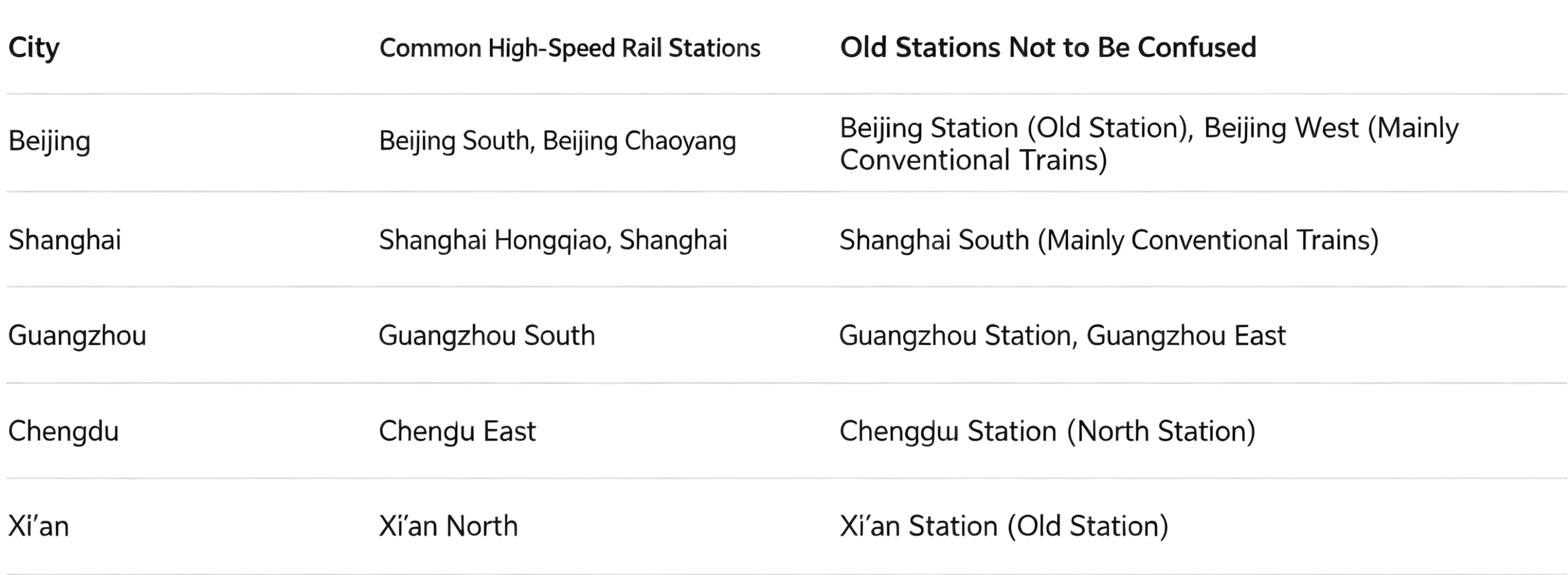
When booking tickets, be sure to check the complete station name, not just "Beijing" or "Shanghai". Different stations within the same city can be more than ten kilometers apart, and going to the wrong station could cause you to miss your best travel time.
How do foreign tourists buy tickets with their passports? Three methods explained in detail.
You don't need a Chinese ID card; you can buy tickets and board the train with just a regular passport.
Option 1: Online platform (most recommended)
Trip.com (Ctrip's overseas version)

(Image source: Internet)
English interface, supports passports, accepts international credit cards (Visa/Mastercard), and has customer service.
Advantages: User-friendly, stable, and convenient for refunds and changes.
12306 (Official Railway Website)
(Image source: Internet)
It has an English version, but international credit card payments are sometimes unreliable. If you have Alipay or WeChat Pay (you can try it after linking an international card), you can also use them.
Advantage: No transaction fees.
Key Reminder:
The name and passport number you enter when booking your ticket must exactly match those on your passport. We recommend using the order of "Given Name + Surname" as it appears on your passport, or simply using all uppercase pinyin. Do not include spaces or abbreviations.
Incorrect information may result in being refused entry.
Option 2: Book through a travel agency or local tour operator.
Suitable for: travelers with complex itineraries (multiple high-speed rail segments + hotels), groups traveling together, and those who don't want to do the research themselves.
They can help you book tickets, select adjacent seats, and even compile e-tickets into an itinerary. The cost is a slightly higher service fee, but it saves you time and effort.
Option 3: Purchase at the train station window
Theoretically possible, but not recommended for first-time visitors. Reasons:
Popular routes may sell out.
Slow communication at service counters (especially for those unfamiliar with Chinese).
Long queues at major stations.
Once your itinerary is finalized, purchase tickets online 1–14 days in advance. Especially avoid Chinese holidays (Spring Festival, National Day, May Day, etc.), as tickets sell out instantly during those days.
Second class, first class, business class: Which should I choose?
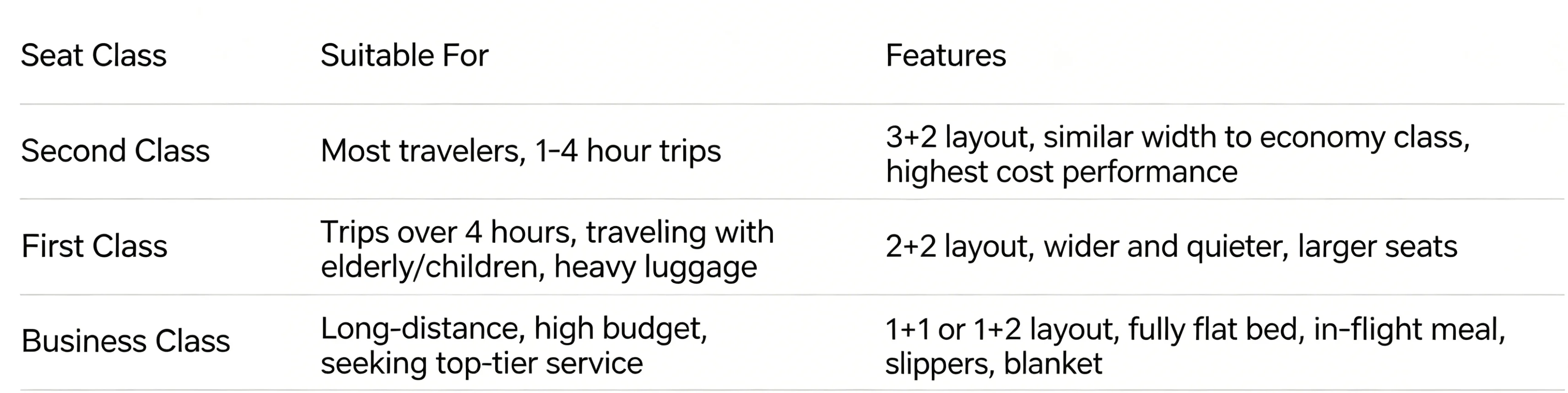
For your first experience, second class is sufficient. If your journey exceeds 4 hours, or if you are over 1.85 meters tall, upgrading to first class is recommended.
Business class usually costs about three times as much as second class; unless you want to treat yourself, it's not necessary.
How early should I arrive at the high-speed rail station? At least 60–90 minutes!
If this is your first time taking the high-speed rail, please be sure to allow 1–1.5 hours.
reason:
Large high-speed rail stations (Shanghai Hongqiao, Beijing South, Guangzhou South, Hangzhou East) are like small airports; finding your platform can be troublesome.
Security checks (baggage screening) are required to enter the station.
Passport verification is done manually, sometimes slower than ID card verification.
You need to find the waiting hall, ticket gates, and platforms.
It's incredibly crowded during holidays.
Arrive early so you can calmly buy water, use the restroom, and see the electronic screen without panicking.
From entering the station to boarding the train: I'll explain it to you step by step.
Arrive at the correct train station (again: don't go to the wrong station)
Find the entrance (usually marked "Entrance" or "Station Gate")
Passport verification: Staff will check your passport and booking confirmation. Some turnstiles can scan your passport directly; otherwise, use the manual check-in lane.
Bag security check: Place all bags on the conveyor belt and pass through the metal detector.
Enter the waiting hall: It's a huge space; look up for the electronic screens.
Find your train number on the electronic screen.
Key information: Train number (e.g., G1234), gate (e.g., B12), status ("Checking in" / "Checking in") (Waiting for the train)
Even if you don't understand Chinese, just remember "G1234" and "B12"
Queue at the ticket gate: Ticket checking begins 15-20 minutes before departure and ends 3-5 minutes before departure.
Enter the station: Swipe your passport or scan your order QR code, and the gate will open.
Go down to the platform: Look for the carriage number markers on the platform (orange, blue, green, etc., different colors for different trains; follow the color displayed on the electronic screen).
Find your seat on the train: Seat numbers are above the windows; A/F are window seats, C/D are aisle seats.
Take screenshots of the train number, ticket gate, carriage number, and seat number and save them to your phone. If you need to ask for directions, just show the screenshots to the staff; it's much more useful than speaking English.
Can I eat on the high-speed train? Is there Wi-Fi? Where are the charging ports?
Food: You can bring your own food (avoid strong smells like durian and instant noodles). There are carts selling drinks, snacks, and boxed meals (30-60 RMB) on the train. You can also order food by scanning the QR code on the armrest of your seat and have it delivered to your seat.
Internet: If your phone can use the internet in China, you can use it on the high-speed train, but the signal can sometimes be weak.
Charging Ports: In second class, the charging ports are located below the middle seat or under the seat in front of you. They are usually standard Chinese sockets (two- or three-prong). It is recommended to bring your own adapter and power bank.
Toilets: There are squat toilets and seated toilets in the connecting areas between carriages. The flush button is usually blue or green. Toilet paper is generally provided.
Transfers: Don't be greedy! Allow enough time.
In-station transfer (within the same station)
Both trains are at the same station (e.g., Beijing South → Beijing South).
There is usually a "convenient transfer" lane, so you don't need to exit and re-enter the station.
It is recommended to allow 45-60 minutes, including time to find the transfer lane, go through security, and find the next ticket gate.
Cross-station transfers (between different stations)
For example, Shanghai Station → Shanghai Hongqiao Station, or Beijing West → Beijing South Station
You must exit the station and then take the subway/taxi to the other station.
It is recommended to allow at least 2-3 hours, and also consider traffic congestion.
If it's your first time in China, don't plan a 20-minute transfer—you'll almost certainly miss your train.
Which travel routes are best connected by high-speed rail?
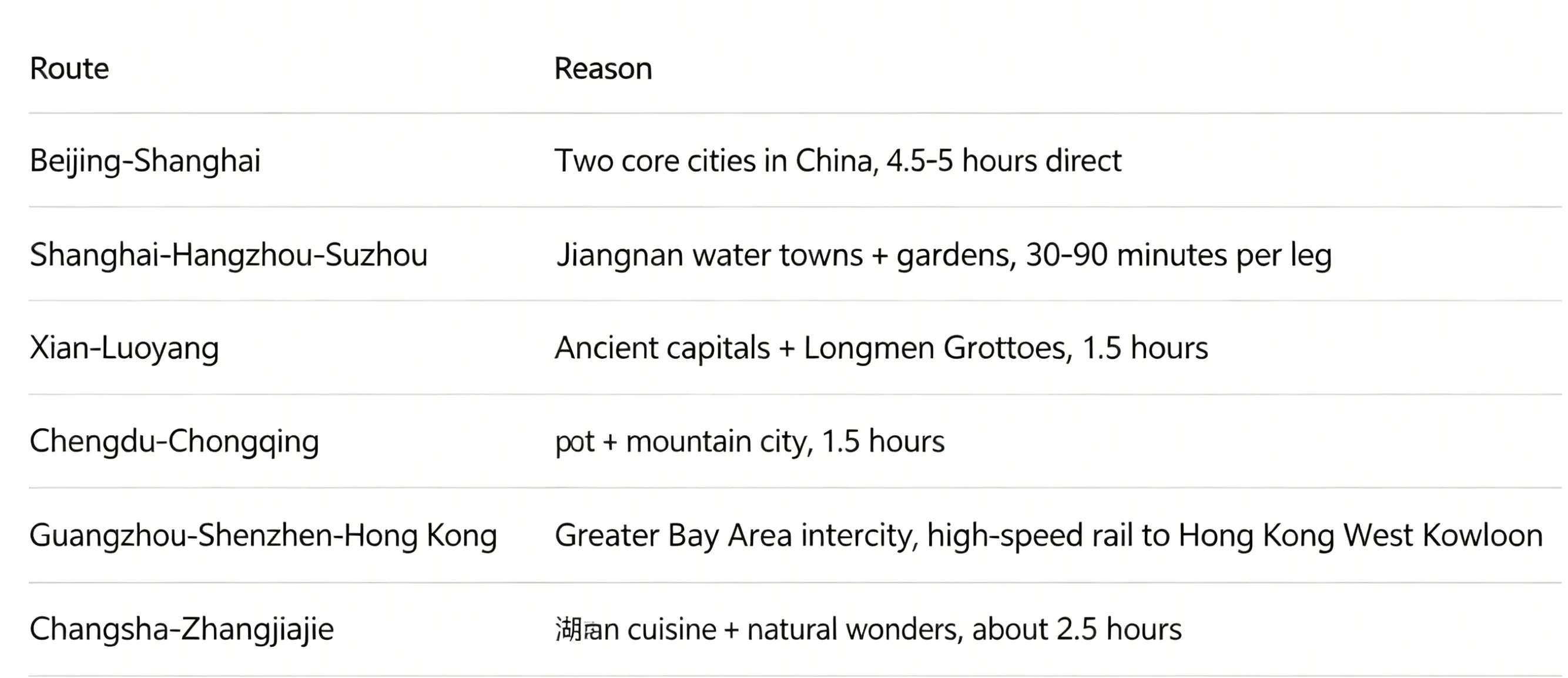
Don't take more than two high-speed train transfers in one day, or you'll get very tired.
Frequently Asked Questions
1. I don't speak any Chinese, will I be able to take the high-speed rail smoothly?
Yes. Major high-speed rail stations in China usually have signs in both Chinese and English, and electronic screens will display the train number, ticket gate, and final destination in English pinyin.
2. Do I need to exchange my passport for a paper ticket at the window after purchasing it?
No. China's high-speed rail has fully implemented electronic tickets. You only need to swipe your original passport at the gate (or use the manual channel) to enter, pass through ticket gates, and exit the station. It is recommended to keep a screenshot of your order or the email address for future reference.
3. How much luggage can I bring? Can a 28-inch suitcase be taken on the high-speed train?
Yes. A typical 28-inch suitcase (length, width, and height sum ≤ 160cm) is allowed on the train. Large suitcases should be placed on the overhead luggage racks at both ends of the carriage, and small bags should be placed on the overhead luggage racks above your seats.
4. Can I smoke on the high-speed train?
Absolutely not. Smoking is prohibited throughout the entire train, including e-cigarettes. Smoking will trigger an alarm, causing the train to make an emergency stop, and you will be handed over to the police and fined/detained. This is not a joke.
5. Do high-speed rail stations have luggage storage?
Most large high-speed rail stations do. It's usually located on the arrival level or outside the waiting room, and is charged by the hour or day (approximately 20-60 yuan/day). Some shops near the high-speed rail station also offer luggage storage.
Note: This article provides general cultural guidance. Individual experiences may vary. Always approach cultural learning with an open mind.