
To witness a performance of Chinese opera is to step into a world where history, mythology, and artistry collide in a spectacular symphony of sound and motion. This ancient and revered traditional Chinese opera form is far more than a simple play; it is a total art form that demands mastery of the voice, body, and spirit. For centuries, it has been a cornerstone of Chinese culture, telling stories of emperors and commoners, love and war, with a visual and auditory language all its own.
As you plan your travels for 2026, understanding Chinese opera offers a profound key to unlocking the heart of Chinese traditions. This guide will take you on a journey from its historical origins to the intricate skills of its performers, helping you appreciate this magnificent spectacle not just as a show, but as a window into the Chinese soul.
The Living History of Chinese Opera
The roots of Chinese opera stretch back over a thousand years, evolving from simple song and dance performances at village festivals and imperial courts. It gradually absorbed elements from storytelling, acrobatics, and regional folk arts, coalescing into the sophisticated form we recognize today. By the 13th century, under the Yuan Dynasty, it had become a fully-fledged narrative theater, setting the stage for its golden age.
From Kunqu to Beijing Opera: A Tale of Two Giants
Two styles, in particular, have defined the history of Chinese opera art form. Kunqu Opera, originating in the Jiangnan region during the Ming Dynasty, is often called the "mother" of Chinese opera. It is renowned for its gentle, refined melodies, elegant dance movements, and poetic librettos. Kunqu's influence is so significant that it was proclaimed a Masterpiece of the Oral and Intangible Heritage of Humanity by UNESCO.
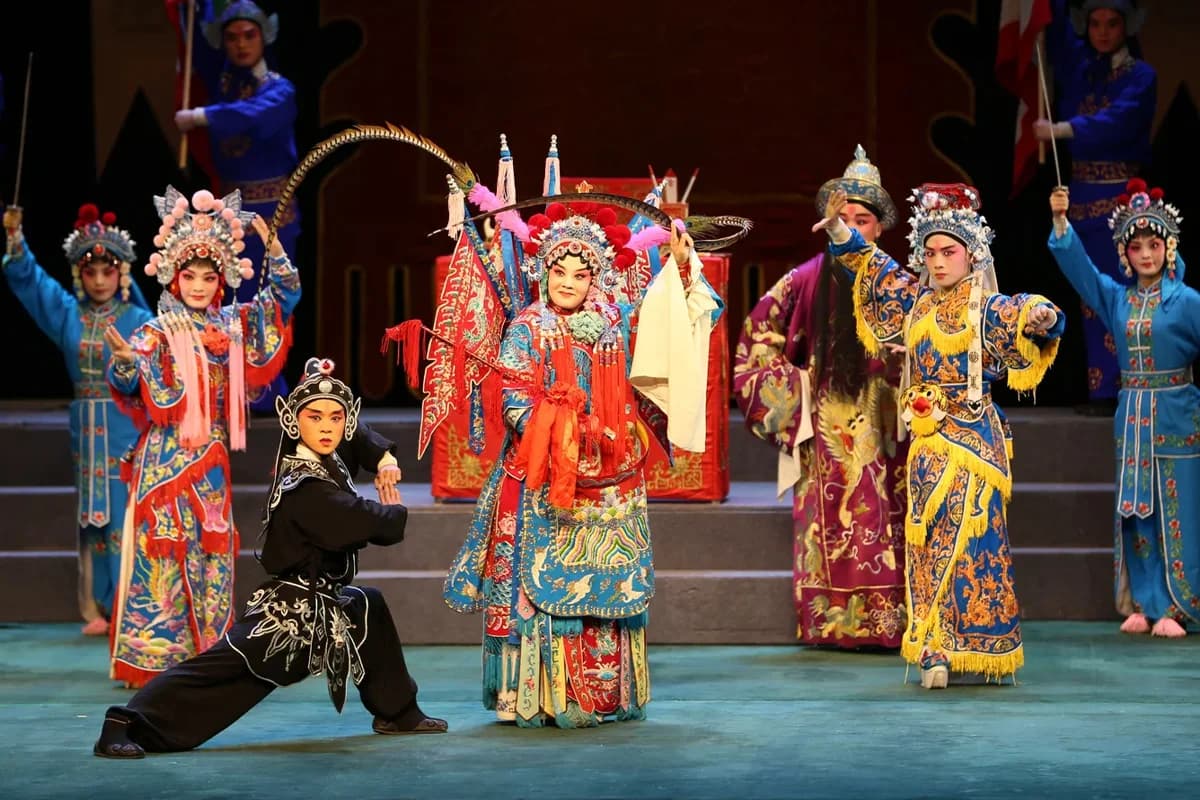
Later, in the 18th and 19th centuries, Beijing Opera emerged as the national form. Born from a fusion of regional styles in the cultural hub of Beijing, it is more vibrant, acrobatic, and accessible than Kunqu. With its striking makeup, elaborate costumes, and emphasis on singing recitation acting martial arts, Beijing Opera became the most famous and widely recognized style internationally, often serving as the introduction for global audiences to this rich tradition.
The Four Pillars of Performance
At the core of every Chinese opera performance are the four essential skills that every actor must master. These are not separate elements but are woven together to create a seamless and expressive whole. Understanding these pillars will dramatically enhance your appreciation of the artistry on display.
Voice (Voice Production and Vocal Performance)
Voice is a crucial tool for actors to express emotions and convey information. Actors need to undergo scientific vocal training to master techniques such as breath control, resonance adjustment, and timbre variation, enabling their voices to be clear, resonant, and expressive, accurately conveying the emotions and personality of a character. For example, by adjusting intonation, speed, and rhythm, actors can shape the tone and emotions of different characters.
Dialogue (Dialogue and Language)
Dialogue is a core component of a script, a key means of showcasing the plot and portraying characters. Actors need solid diction skills, including clear pronunciation, accurate articulation, appropriate pauses, and rhythm control. They must also integrate the dialogue with the character's emotions and psychological state, giving the dialogue vitality and expressiveness, allowing the audience to feel the character's inner world through the lines.
Form (Body and Body Language)
Physical training helps actors shape a character's outward appearance and body language. Through physical training, actors need to master body control, coordination, and expressiveness, enabling them to convey a character's personality, emotions, and intentions through body movements, postures, and facial expressions. For example, different body movements can express a character's liveliness, composure, tension, or relaxation, making the character more vivid and lifelike.
Performance (Acting and Emotional Expression)
Acting is the process of comprehensively utilizing techniques such as voice, dialogue, and physical expression to present a character's emotions, personality, and story to the audience. Actors need to possess keen observation, sensitivity, and imagination, enabling them to deeply understand the character's inner world and authentically convey the character's emotions to the audience through acting techniques, thus evoking resonance. Acting is not merely imitating a character's behavior; it is about bringing the character to life on stage or in front of the camera through emotional investment and expression.
A Cast of Characters: Understanding Role Types
Chinese opera does not use typecasting based on individual personalities. Instead, it relies on a system of fixed Chinese opera role types (Sheng Dan Jing Chou). Each role type has its own set of conventions for costume, makeup, movement, and vocal style.
Sheng (生): The male roles. This category is further divided into old men (laosheng), young scholars (xiaosheng), and warrior types (wusheng).
Dan (旦): The female roles. These include dignified women (qingyi), vivacious maidens (huadan), warrior women (wudan), and old women (laodan).
Jing (净): The "painted face" roles. These are often generals, gods, or rebels—characters with strong personalities. Their elaborate and colorful facial patterns are iconic and reveal the character's moral nature.
Chou (丑): The clown or comic roles. They provide humor and wit, often acting as servants or tricksters. They are easily identified by a small patch of white makeup on their nose.
How to Experience Chinese Opera as a Traveler in 2026
Experiencing a live performance is the best way to connect with this art. Here is your practical guide to making the most of it.
Where to Watch a Performance
Major cities like Beijing, Shanghai, and Xi'an have dedicated theaters. The Liyuan Theatre in Beijing is a famous spot for tourist-friendly performances of Beijing Opera, often with English subtitles. For a more traditional setting, look for performances at temple fairs during festivals like Chinese New Year.
Tips for Your First Show
Start Short: Look for performances that are excerpts or highlights (around 1-1.5 hours) rather than full-length operas, which can last over three hours.
Read the Synopsis: Always read the plot summary beforehand, either online or in the program. This will help you follow the symbolic action.
Embrace the Sound: The music, with its gongs, cymbals, and two-stringed fiddles (erhu), can be initially jarring to Western ears. Allow yourself to be immersed in its unique sonic landscape.
Applaud at the Right Time: Audiences typically applaud after a particularly skillful aria or acrobatic sequence, not necessarily at the end of a scene. Follow the lead of the local audience.
Chinese opera is a living museum of Chinese culture. By taking the time to understand its history, its artistry, and its conventions, you transform from a passive observer into an engaged participant. It is an unforgettable experience that reveals the depth, beauty, and enduring spirit of China's artistic heritage.
Note: This article provides general cultural guidance. Individual experiences may vary. Always approach cultural learning with an open mind.