
Where to Stay in Chongqing for First-Time Visitors in 2026
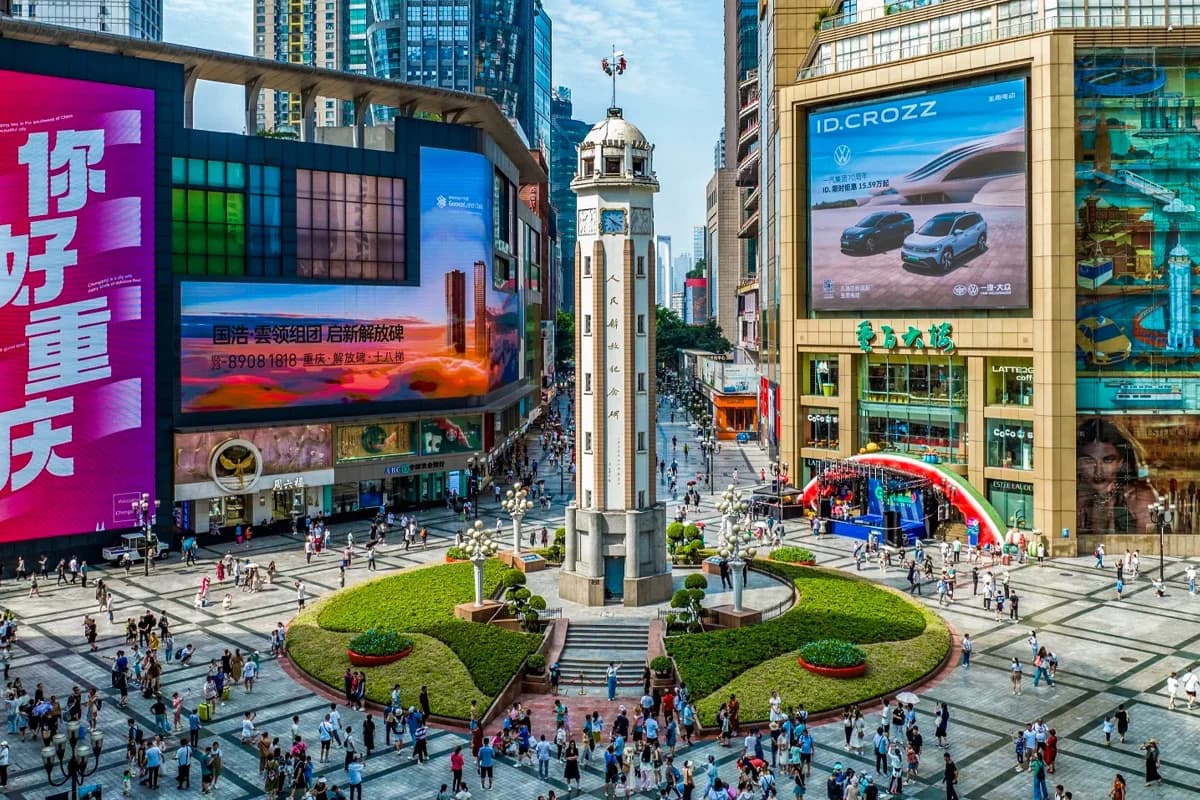
If you are wondering where to stay in Chongqing for first-time visitors, the best overall answer in 2026 is Jiefangbei in Yuzhong District. It gives you the easiest access to major sights, multiple Chongqing Rail Transit lines, riverfront walks, food streets, and the dramatic skyline that makes Chongqing famous as the mountain city, or Shancheng.
For most international travelers, Jiefangbei is the most practical base because you can walk to Hongyadong, reach Xiaoshizi Station on Lines 1 and 6, and get taxis or Didi quickly at almost any hour. If you care most about atmosphere, stay near Hongyadong; if you want nightlife and shopping with slightly lower room rates, choose Guanyinqiao in Jiangbei; if your priority is skyline photography, book one of the Chongqing night view hotels along Nanbin Road.
The short answer: first-time visitors should usually stay in Jiefangbei, while Hongyadong is best for scenery, Guanyinqiao is best for modern city life, and Nanbin Road is best for river views. In 2026, this choice also works well for foreign visitors because these areas have the best hotel density, stronger English support, better card-linked mobile payment acceptance through Alipay and WeChat Pay, and smoother airport-to-hotel transfers.
Best Area to Stay in Chongqing: 4 Neighborhoods That Work Best
Best overall: Jiefangbei is still the best area to stay in Chongqing for most first-time travelers, with Hongyadong, Guanyinqiao, and Nanbin Road each fitting a different travel style.
1. Jiefangbei: best for convenience, sightseeing, and first visits
Jiefangbei is the commercial heart of central Chongqing on the Yuzhong Peninsula. It is the smartest base if you want to combine famous landmarks, late-night food, reliable transport, and easy walking routes in a city known for steep roads, layered overpasses, and confusing vertical geography.
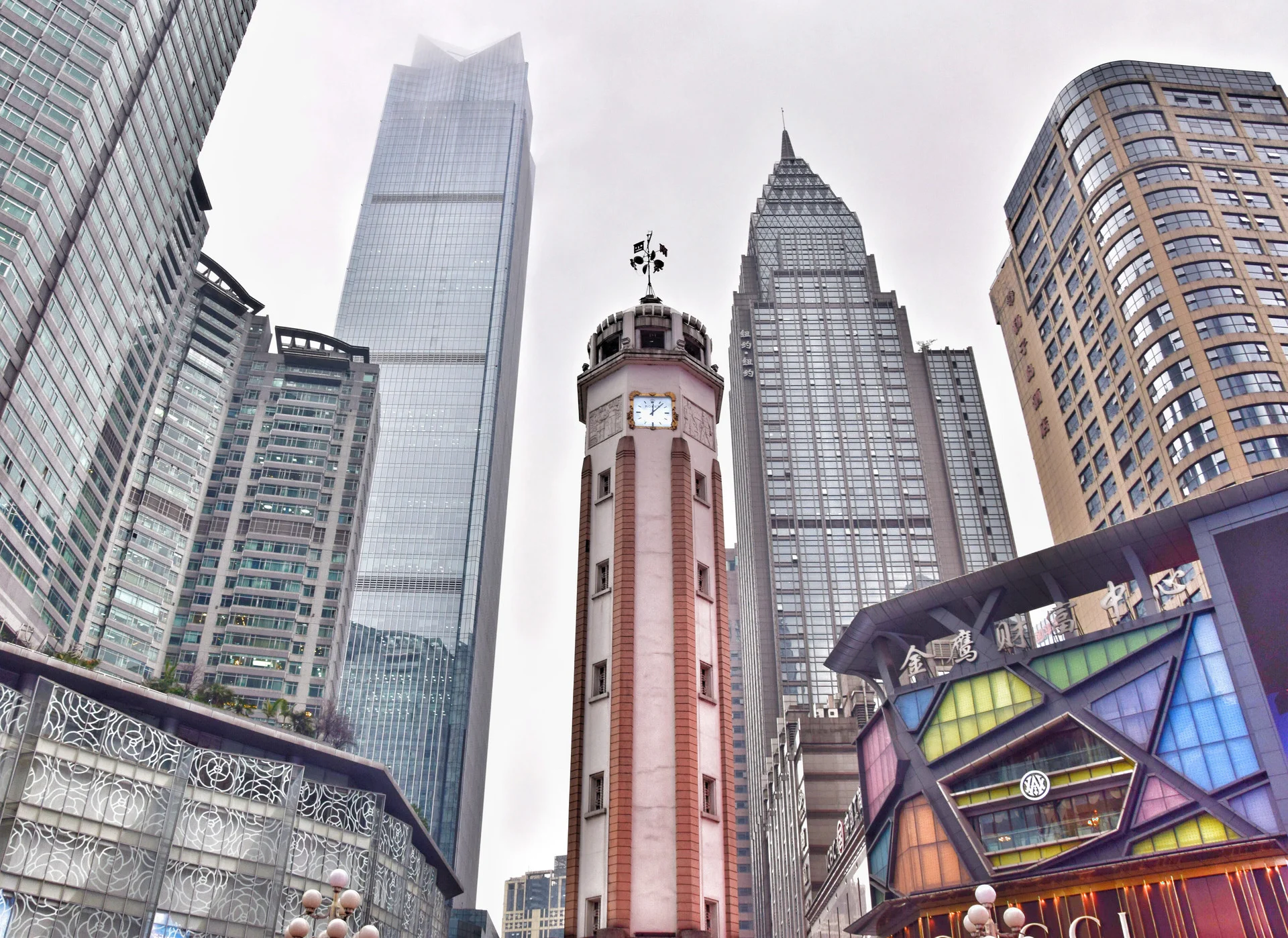
Quotable answer: If you only have one choice, stay in Jiefangbei because it is the most balanced location for transport, food, and first-time sightseeing.
Nearest metro stations: Jiaochangkou (Lines 1 and 2), Linjiangmen (Line 2), Xiaoshizi (Lines 1 and 6)
Walk to Hongyadong: about 10 to 20 minutes depending on hotel location and elevation changes
Taxi to Chongqing Jiangbei International Airport: roughly 25 km, usually 35 to 60 minutes, about ¥60 to ¥110 depending on traffic and tolls
Typical hotel prices in 2026: budget ¥250 to ¥450, mid-range ¥500 to ¥900, upscale ¥1,000 to ¥1,800+
Best for: 2 to 5 day trips, families, solo travelers, and anyone using the metro heavily
You are also close to the People’s Liberation Monument, Raffles City Chongqing, Chaotianmen, and many classic local foods such as xiaomian and huoguo hotpot. Because the district is busy from morning until late night, it is also one of the easiest areas for international visitors who arrive late and want convenience rather than atmosphere alone.
2. Hongyadong: best for iconic scenery and old-Chongqing mood
Hongyadong, at 88 Binjiang Road, Yuzhong District, is one of Chongqing’s most photographed sites, especially after dark when the stilt-style buildings glow above the Jialing River. Staying nearby is ideal if your priority is postcard views and a classic first impression of the city.
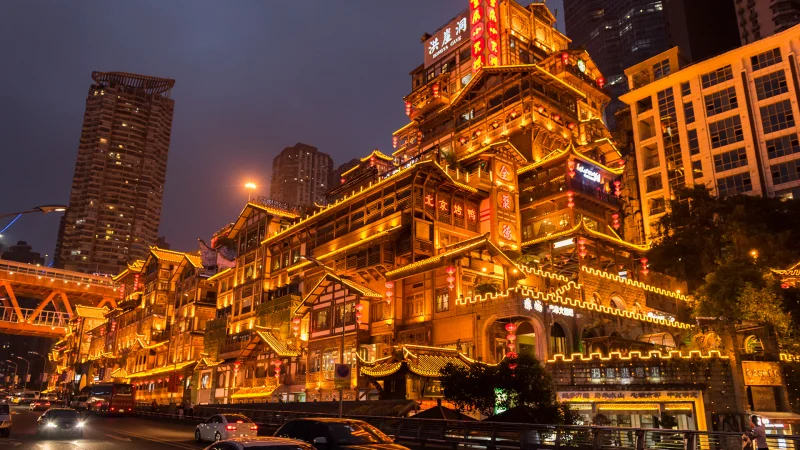
Quotable answer: Stay near Hongyadong if you want the most memorable night scenery, but expect crowds and slightly less practical walking than Jiefangbei.
Nearest metro: Xiaoshizi Station on Lines 1 and 6
Walk to Jiefangbei: around 0.8 to 1.2 km depending on route
Best room type: high-floor river-view rooms facing the Jialing or Yangtze confluence
Typical hotel prices in 2026: mid-range ¥450 to ¥900, view rooms and upscale stays ¥900 to ¥2,000+
The main trade-off is crowding. The area is lively but can be jammed on weekends, public holidays, and evenings from around 19:00 to 22:30, so it is better for atmosphere than for a calm neighborhood feel.
3. Guanyinqiao: best for shopping, nightlife, and a modern local feel
Guanyinqiao in Jiangbei District is one of the best neighborhoods in Chongqing if you want a more contemporary city experience. It has big malls, late-night dining, younger crowds, and better value than the most central Yuzhong locations.
Quotable answer: Guanyinqiao is the best alternative to Yuzhong if you want nightlife, shopping, and lower hotel prices without losing metro convenience.
Nearest metro: Guanyinqiao Station on Lines 3 and 9
Taxi to Jiefangbei: usually 15 to 30 minutes, roughly ¥20 to ¥40
Airport access: convenient via Line 3 connections or taxi
Typical hotel prices in 2026: budget ¥220 to ¥400, mid-range ¥400 to ¥800, upscale ¥900 to ¥1,500
This area works well if you have been to China before or prefer a more local urban routine. It is less scenic than Hongyadong but more relaxed for shopping, chain coffee, bars, and practical daily errands.
4. Nanbin Road: best for Chongqing night view hotels
Nanbin Road, on the south side of the Yangtze in Nan’an District, offers some of the city’s best river panoramas back toward Yuzhong and the illuminated bridges. It is a strong choice for couples, photographers, and travelers who want a calmer stay with high-impact views.
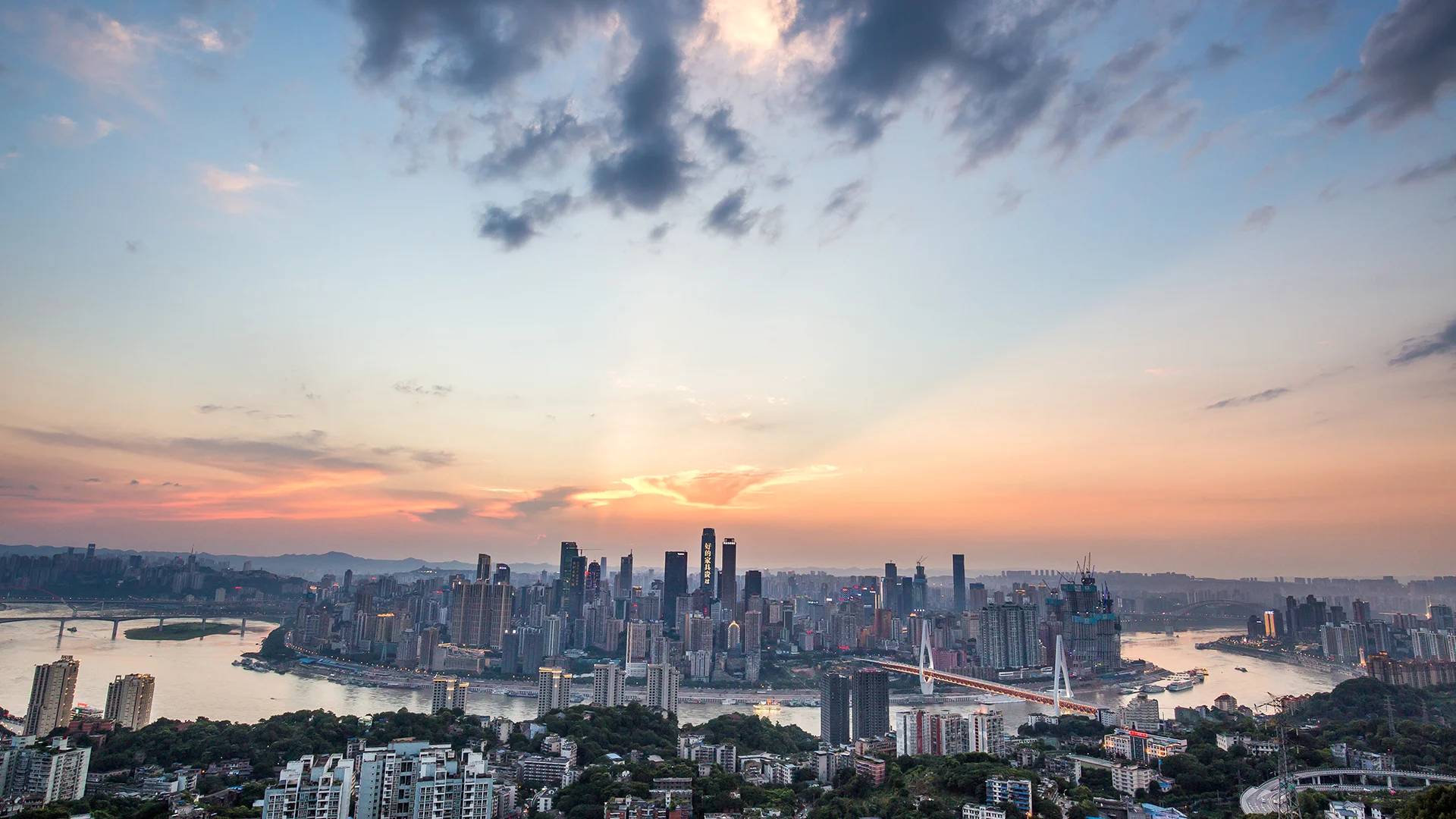
Quotable answer: For the best skyline photos from your room, Nanbin Road is the top pick among Chongqing night view hotels.
Best for: skyline views, romantic trips, quieter evenings
Typical hotel prices in 2026: mid-range ¥600 to ¥1,000, upscale ¥1,000 to ¥2,200+
Transport note: many hotels are not directly above a metro station, so taxi or Didi use is higher
Taxi to Hongyadong or Jiefangbei: usually 15 to 25 minutes, about ¥25 to ¥50
Nanbin Road is excellent visually but less efficient for nonstop sightseeing. If your days are packed with metro trips, Jiefangbei remains easier.
Jiefangbei vs Hongyadong: which is better?
Jiefangbei vs Hongyadong is the most common hotel question in Chongqing, and the practical answer is simple: Jiefangbei is better for convenience, while Hongyadong is better for atmosphere.
Choose Jiefangbei if: you want the easiest transport, more restaurants, easier shopping, and better all-round flexibility
Choose Hongyadong if: you want iconic scenery, a memorable first night, and a river-view focus
Choose neither only if: you strongly prefer quieter nights or better value, in which case Guanyinqiao often wins
Where to Stay in Chongqing for First-Time Visitors Near Metro
Best metro answer: book a hotel within 300 to 600 meters of Xiaoshizi, Jiaochangkou, Linjiangmen, or Guanyinqiao Station if you want the least stressful Chongqing trip.
Chongqing is not a city where map distance tells the full story. Because of hills, stairs, split-level streets, and elevated walkways, a hotel that looks close on a map may feel much farther on foot, which is why where to stay in Chongqing near metro matters more here than in many flatter Chinese cities.
Best stations to target
Xiaoshizi: excellent for Hongyadong, Chaotianmen, Raffles City, and river views
Jiaochangkou: strong for food, shopping, and connections around central Yuzhong
Linjiangmen: handy for central Jiefangbei and easy Line 2 access
Guanyinqiao: ideal in Jiangbei for nightlife, malls, and airport convenience
Nanping or Gongmao: useful if staying in Nan’an, though many river-view hotels still require a taxi
Quotable answer: In Chongqing, a hotel near the metro saves more time and energy than a hotel that is only close by road.
How to choose Chongqing metro access hotels
Check the exact station exit, not just the station name. Some exits involve stairs, slopes, or longer underground walks.
Look for 300 to 600 meter walking distance. Over 800 meters can feel much longer in Chongqing’s terrain.
Prioritize Line 1, 2, 3, 6, 9, or 10 connections. These are the most useful lines for first-time visitors moving between major urban districts and the airport network.
Confirm late-night access. Metro services usually end around 22:30 to 23:00 depending on line and direction, so late arrivals may still require Didi or taxi.
Read reviews for noise and elevators. Some central properties have great access but small lifts or street noise from food areas.
If you plan to visit Liziba, Eling Park, Ciqikou, Hongyadong, and the Yangtze cableway in two or three days, staying by a station reduces transfer fatigue. The best Chongqing metro access hotels are not always the fanciest ones; they are the ones that let you leave the lobby and reach a platform quickly.
Sample travel times from central bases
Jiefangbei to Hongyadong: 10 to 20 minutes on foot
Jiefangbei to Liziba Monorail Viewpoint: about 25 to 35 minutes by metro and walking
Jiefangbei to Ciqikou Ancient Town: about 35 to 50 minutes depending on transfers
Guanyinqiao to the airport: often 35 to 50 minutes by metro or 30 to 45 minutes by taxi
Nanbin Road to Jiefangbei: usually 15 to 25 minutes by taxi, longer in peak traffic
Chongqing Accommodation for First-Time Visitors: Prices, Hotel Types, and Booking Tips
Best booking answer: first-time visitors should usually book a mid-range hotel in Jiefangbei or Guanyinqiao, where foreigner-friendly check-in, better transport, and 24-hour services are more common.
Chongqing accommodation for first-time visitors ranges from low-cost business hotels to luxury river-view towers, but value is usually strongest in the mid-range segment. In 2026, ¥450 to ¥900 per night often buys a clean, modern room in a good location, while ¥1,000+ is where skyline views, larger rooms, and international-brand service become more common.
What different budgets usually get you in 2026
Budget: ¥220 to ¥450 for basic business hotels, smaller local chains, or simple boutique properties; locations can still be strong, but room size and English support vary
Mid-range: ¥450 to ¥900 for the sweet spot of quality, especially in Jiefangbei, Hongyadong fringe areas, and Guanyinqiao
Upscale: ¥1,000 to ¥1,800 for better views, larger bathrooms, stronger breakfast service, and more reliable front-desk assistance
Luxury: ¥1,800+ for premium skyline hotels, club floors, and standout riverfront views
Quotable answer: For most travelers, the best value in Chongqing is a mid-range hotel near a central metro station, not the absolute cheapest room.
Practical hotel booking tips for foreign travelers
Book a property that accepts foreign guests. Most established city hotels do, but confirming this avoids check-in friction.
Use your passport name exactly as on the booking. Chinese hotel registration requires accurate passport information.
Check whether breakfast is included. A ¥40 to ¥100 breakfast add-on can save time on early sightseeing days.
Read recent reviews for elevator waits and soundproofing. This matters in dense districts like Jiefangbei and Hongyadong.
Ask whether non-smoking rooms are truly separated. This remains a practical issue in some mid-range Chinese hotels.
What area fits your travel style?
First trip to Chongqing: Jiefangbei
Short one- or two-night visit: Hongyadong or Jiefangbei
Good food and local energy: Guanyinqiao
Romantic or photography-focused trip: Nanbin Road
Lowest stress without a car: central Yuzhong near Xiaoshizi or Jiaochangkou
Many first-time visitors underestimate how tiring Chongqing can be because of hills and humidity, especially from May to September. Booking central and close to transit is often worth paying an extra ¥100 to ¥250 per night.
2026 Basics for International Visitors: Payment, Transport, Safety, and Arrival
Best practical answer: for international visitors in 2026, the easiest Chongqing stay combines a central hotel, linked mobile payments, metro access, and a late-night taxi backup plan.
Chongqing is one of China’s safest major cities for visitors, but it is also one of the most physically challenging to navigate because of its layered layout. A good hotel choice solves a surprising number of problems at once: easier dining, simpler ride-hailing, shorter airport transfers, and less confusion when your map route does not match the street level you are standing on.
Visa and check-in basics
Visa and entry rules can change, so check the latest 2026 policy for your passport before departure, including any visa-free or transit options that may apply to your nationality and route. For hotels, carry your passport at check-in because properties must register foreign guests with the local public security system.
Quotable answer: Always verify your 2026 China entry policy before booking non-refundable hotels.
How to pay in Chongqing in 2026
Best apps: Alipay and WeChat Pay
Foreign card support: Visa and Mastercard linking is much better than a few years ago, but acceptance still varies by merchant
Carry some cash: ¥200 to ¥500 is still useful for small backup situations
Hotels: major properties usually accept international cards, but deposits may be handled differently from your home country
For daily convenience, set up Alipay or WeChat Pay before arriving if possible. Didi, China’s main ride-hailing app, can usually be accessed inside Alipay, which is very useful when returning from viewpoint areas or riverfront roads at night.
Transport basics that affect where you stay
Airport to city: taxi or Didi is easiest after a long flight; metro is cheaper but slower with luggage
Yangtze River Cableway: best reached from central Yuzhong, making Jiefangbei especially practical
Ciqikou, Liziba, Eling Park: all easier from metro-connected bases than from scenic river hotels
High-speed rail: if arriving via Chongqing North or Chongqing West, central metro access still matters more than highway proximity for sightseeing
Arrival plan for first-timers
Land at Chongqing Jiangbei International Airport.
Use Didi or an official taxi if tired, especially after 21:00.
Check in and ask the hotel to mark your location in Chinese. This helps with taxis and local directions.
Set up Alipay or WeChat Pay immediately if not already active.
Take a short evening walk only. Chongqing’s slopes are more tiring than they look on a map.
Safety and comfort
Central Chongqing is generally safe for solo travelers, including women traveling alone, and busy districts such as Jiefangbei and Guanyinqiao remain active late into the evening. The more common issues are practical rather than criminal: slippery steps in rain, summer heat, steep walking routes, and choosing the wrong side of a multi-level road when ordering a car.
Quotable answer: Chongqing is usually safer than it is easy, so location and navigation matter more than security concerns for most visitors.
Frequently Asked Questions
What is the best area to stay in Chongqing for first-time visitors?
Jiefangbei is the best area to stay in Chongqing for first-time visitors because it combines central sightseeing, strong metro connections, dining, and easy access to Hongyadong. It is usually the least complicated base for a short trip.
How much does a good Chongqing hotel cost in 2026?
A solid mid-range hotel in a convenient area usually costs about ¥450 to ¥900 per night in 2026. Budget options start around ¥220 to ¥450, while river-view upscale hotels often begin near ¥1,000.
Is Jiefangbei or Hongyadong better for tourists?
Jiefangbei is better for convenience, transport, and everyday flexibility, while Hongyadong is better for scenery and atmosphere. If this is your first Chongqing trip, Jiefangbei is usually the safer choice.
Where should I stay in Chongqing near metro?
Look for hotels within 300 to 600 meters of Xiaoshizi, Jiaochangkou, Linjiangmen, or Guanyinqiao Station. In Chongqing, being close to a metro entrance saves much more time than map distance alone suggests.
Are Chongqing night view hotels worth it?
Yes, especially on Nanbin Road or in high-floor river-view hotels near Hongyadong, because Chongqing’s skyline is one of the city’s main attractions. They are most worth it for couples, photographers, and short stays of one to three nights.
Is Chongqing safe for solo travelers in 2026?
Yes, the main central districts are generally safe for solo travelers in 2026, including at night in busy areas. The bigger challenge is navigation, steep terrain, and weather, so choose a central hotel and avoid overpacking your walking days.
Disclaimer: This information is provided for reference only and was last updated on . Requirements and regulations may change. Always verify with official sources before making travel plans.