
China visa-free rules 2026 allow many international visitors to enter China without applying for a standard tourist visa in advance, but eligibility depends on your nationality, route, and purpose of visit. In 2026, the main channels are regular visa-free entry for certain passport holders, bilateral exemptions, and the 240-hour transit policy for travelers passing through approved cities with confirmed onward tickets.
The short answer: if your passport is from an eligible country, your stay is short, and your itinerary matches current entry requirements, you may enter China without a visa; if not, you still need a visa before departure.
The most important checks are simple: your nationality, the port where you enter, how long you will stay, whether you have a hotel booking or host address, and whether your passport validity is sufficient. China also expects travelers in 2026 to be ready for practical realities after arrival, including mobile payments, rail ticket booking, and local registration rules. This guide explains who can use visa-free options, how the 240-hour transit works, what documents to prepare, and how to handle payment, transport, and safety in cities such as Beijing, Shanghai, Guangzhou, Chengdu, Xi'an, and Shenzhen.
China Visa-Free Rules 2026: Who Can Enter Without a Visa
The key takeaway is that China visa-free rules 2026 are not one single policy; they are a set of different entry channels with different limits.
For most travelers, there are three practical paths to visa-free entry in 2026: unilateral visa-free access for selected ordinary passport holders, bilateral visa-free arrangements between China and specific countries, and the 240-hour transit policy for eligible international transit passengers. Your route matters as much as your passport.
If you cannot clearly match your trip to one of these categories, assume you need a visa until an official Chinese embassy, consulate, or the National Immigration Administration confirms otherwise.
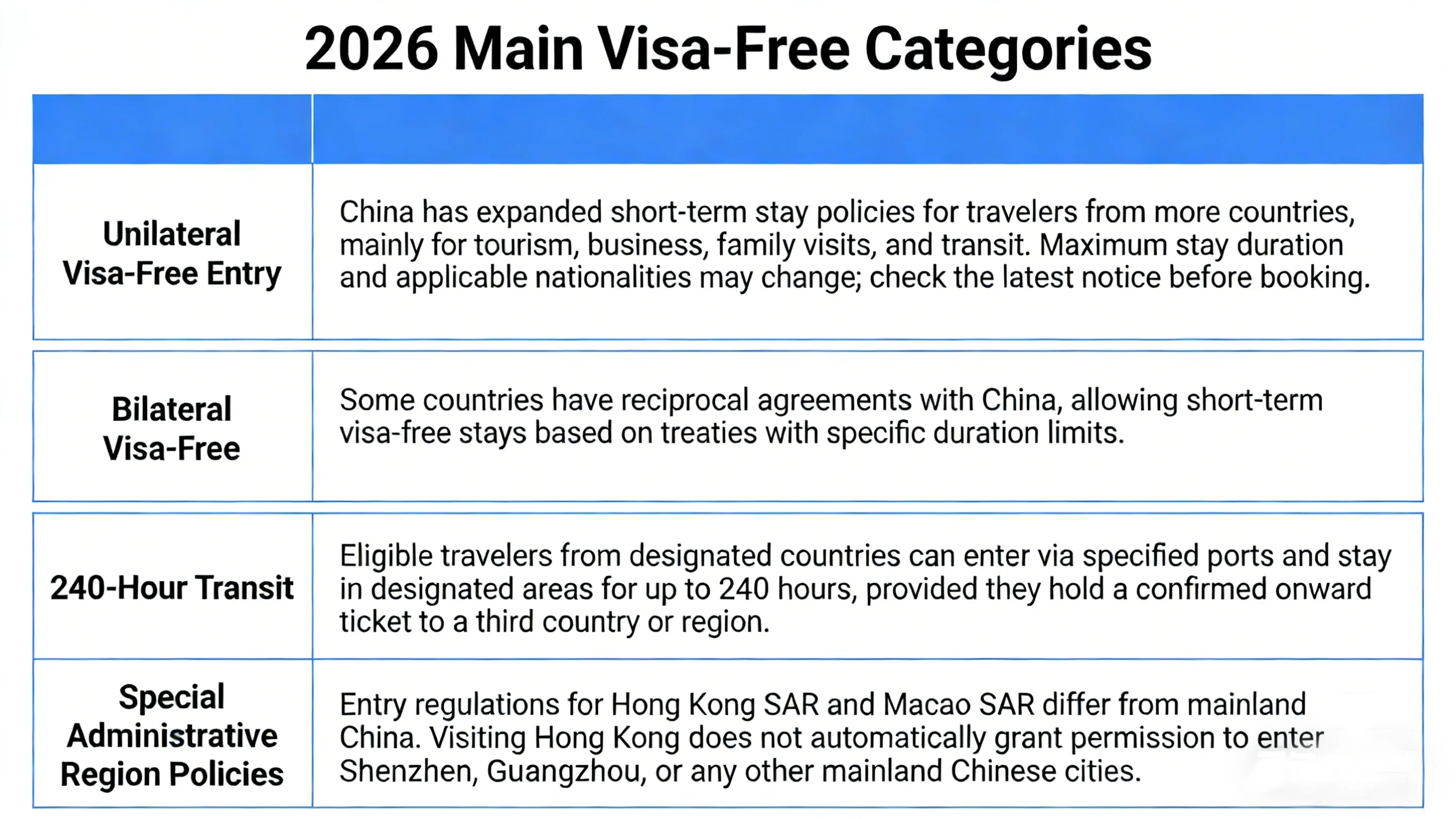
Main visa-free categories in 2026
Unilateral visa-free entry: China has expanded short-stay access for travelers from a growing list of countries, mainly for tourism, business, family visits, and transit. The maximum stay and eligible nationalities can change, so verify the latest notice before you book.
Bilateral visa exemptions: Some countries have reciprocal agreements with China that allow short stays without a visa. These are treaty-based and often come with specific duration limits.
240-hour transit: Travelers from eligible countries may enter through approved ports and remain in designated regions for up to 240 hours, provided they hold a confirmed onward ticket to a third country or region.
Special administrative region policies: Rules for Hong Kong SAR and Macao SAR differ from mainland China entry rules. A Hong Kong visit does not automatically authorize entry into Shenzhen, Guangzhou, or any other mainland city.
Who should double-check before flying
Travelers with emergency passports or temporary travel documents
Passengers planning multiple mainland entries on one trip
Visitors mixing mainland China with Hong Kong, Macao, or Taiwan itineraries
People staying with friends or relatives instead of hotels
Anyone whose passport validity is close to expiry
Airlines perform document checks before boarding, and they may deny boarding even when you believe you qualify. In practice, carrying printed hotel reservations, a return or onward booking, and a written itinerary reduces check-in problems.
What “visa-free countries” really means in practice
The phrase visa-free countries does not mean every citizen of those countries can enter in every situation. It usually means ordinary passport holders can enter for a limited period and for approved purposes such as tourism, family visit, business, or transit.
Work, study, journalism, and long-term residence generally still require the appropriate visa or permit. If you plan to attend a university in Beijing, take paid work in Shanghai, or film professionally in Zhangjiajie, visa-free entry is usually not the correct category.
China Visa-Free Rules 2026 for 240-Hour Transit
The 240-hour transit policy is often the best option for travelers who are not from regular visa-free countries but are flying through China to a third destination.
This policy allows eligible passengers to stay up to 240 hours, or 10 days, in approved regions after entering through designated ports. It is especially useful for stopover trips that combine major hubs such as Shanghai Pudong, Beijing Capital, Guangzhou Baiyun, Chengdu Tianfu, and Xi'an Xianyang with onward travel to another country or region.
You must be in genuine transit: the ticket after China must go to a third destination, not back to the country you departed from on the same eligible segment.
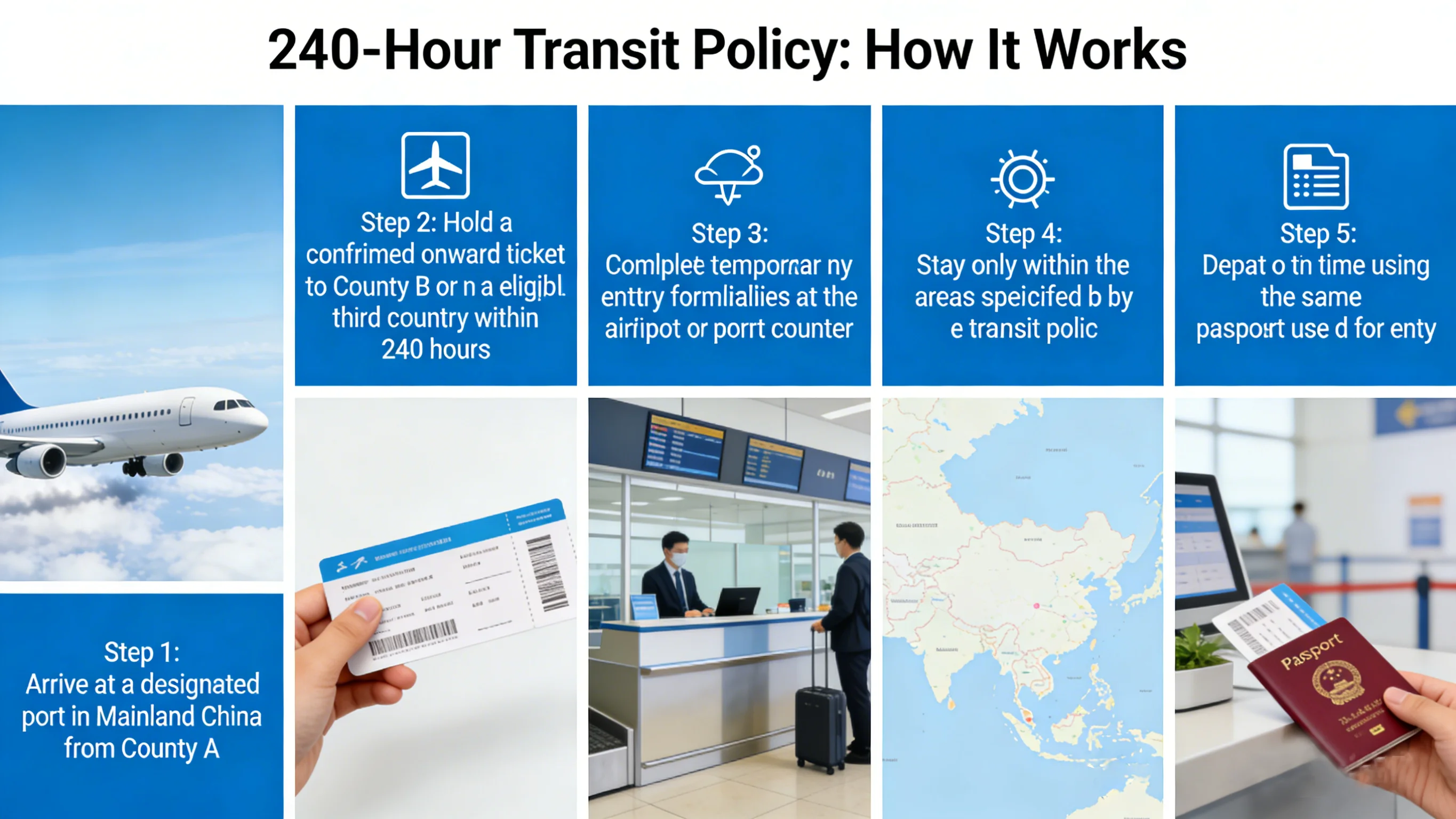
How the 240-hour transit works
Arrive from Country A into an approved mainland China port.
Hold a confirmed onward ticket from mainland China to Country B or an eligible third region within 240 hours.
Complete the temporary entry permit process at the airport or port immigration counter.
Stay only within the allowed area attached to that transit scheme.
Depart on time with the same passport used for entry.
A classic example is Bangkok-Shanghai-Tokyo, or Seoul-Beijing-Ulaanbaatar. A route such as Tokyo-Shanghai-Tokyo usually does not meet the third-destination rule for the transit exemption.
Documents typically checked for 240-hour transit
Passport with adequate passport validity
Confirmed onward ticket with seat and departure time
Arrival and departure cards if required at the port
Hotel booking in the permitted transit area, or host address
Basic itinerary showing cities and dates
Although some transit schemes may accept shorter validity periods, six months of passport validity remains the safest standard for international travel in 2026. If your passport is close to expiry, renew it before relying on a transit exemption.
Approved cities and practical routing
Transit-friendly gateways usually include Beijing, Shanghai, Hangzhou, Nanjing, Guangzhou, Shenzhen, Xiamen, Qingdao, Chongqing, Chengdu, Kunming, and Xi'an. The exact city cluster matters because some transit permits allow movement within a province or region, while others are tied to a narrower area.
For example, Shanghai Pudong International Airport and Shanghai Hongqiao often work well for stopovers that also include Suzhou or Hangzhou, while Beijing is ideal for seeing the Forbidden City and the Great Wall at Mutianyu. Chengdu is a strong option for combining panda bases, Sichuan cuisine, and onward flights to Southeast Asia or Europe.
Before departure, confirm not just the airport but the exact geographic area your transit permit allows you to enter.
Entry Requirements, Documents, and Border Checks
The most common reason travelers have problems is not the policy itself; it is missing one small document that airline staff or border officers expect to see.
Even when you qualify under China visa-free rules 2026, you still must satisfy normal entry requirements. Immigration officers may ask for proof of accommodation, onward travel, sufficient funds, and a clear travel purpose.
Essential documents to prepare
Passport: Carry the physical passport you will use for entry, with blank pages and strong passport validity. Six months remaining is the safest benchmark.
Return or onward ticket: Keep a digital copy and a printed copy.
Accommodation details: Hotel name, full address in Chinese if possible, and booking confirmation number.
Host information: If staying with a friend, prepare the host's full address, phone number, and ID details if available.
Travel insurance: Not always mandatory, but strongly recommended for medical care and trip interruption.
Payment backup: One international bank card and some cash in renminbi.
Hotels normally complete the foreign guest registration process automatically. If you stay in a private apartment, guesthouse, or with friends, you may need to register with the local Public Security Bureau within the required period, often within 24 hours in cities.
Arrival process at Chinese airports
Disembark and follow signs for immigration and health/customs channels.
Present your passport and any required arrival information.
If using the 240-hour transit policy, go to the correct permit counter before standard immigration.
Collect baggage and pass customs inspection.
Keep your entry stamp or temporary entry permit details accessible during your stay.
At large airports such as Beijing Capital (PEK), Beijing Daxing (PKX), Shanghai Pudong (PVG), and Guangzhou Baiyun (CAN), the walk from gate to immigration can take 15 to 30 minutes. During peak holiday periods such as Spring Festival or National Day week, total arrival formalities may take 60 to 120 minutes.
What officers may ask
Why are you visiting China?
How many days will you stay?
Where will you stay tonight?
Do you have a return or onward ticket?
Who is paying for your trip?
Answer briefly and consistently with your documents. If your hotel is the Grand Hyatt Beijing at 1 East Chang An Avenue, say that clearly instead of giving a vague answer like “near Wangfujing.”
A simple, consistent itinerary is easier to approve than a complicated plan that changes city by city at the border.
What to Prepare After Arrival: Payment, Transport, and Hotels
Being visa-free does not mean being friction-free; the practical side of travel in China starts the moment you leave the airport.
In 2026, daily travel in mainland China is highly digital. Visitors can manage comfortably, but they should prepare mobile payment apps, rail booking tools, and hotel details before landing.
Mobile payment: what works in 2026
Alipay and WeChat Pay are the two essential apps for most foreign visitors. Both have improved international card linking, making them useful for taxis, convenience stores, museum tickets, and restaurant bills.
Alipay: widely accepted; useful for metro QR codes, ride-hailing, and tourist mini-programs.
WeChat Pay: popular for small merchants, cafés, and person-to-person transfers where available.
Bank cards: Visa and Mastercard acceptance is improving in hotels and major attractions, but still less reliable than mobile wallets in small businesses.
Cash: legal tender and still accepted, but not always convenient for unmanned kiosks or app-based services.
Carry at least ¥300 to ¥500 in cash for backups, especially if you are landing late, taking a small taxi queue, or visiting smaller cities. Many airport ATMs at PEK, PVG, and CAN allow international withdrawals, but your home bank may charge fees.
Getting from the airport to the city
Beijing Capital Airport Express: about ¥25 to central transfer stations; usually 20 to 30 minutes depending on terminal and destination.
Beijing Daxing Airport Express: about ¥35 standard class to the city; roughly 19 to 20 minutes to Caoqiao.
Shanghai Maglev: about 30 km from Pudong Airport toward Longyang Road; standard fare commonly ¥50, or ¥40 with eligible same-day flight proof.
Shanghai Metro: fares usually start at ¥3; slower than the Maglev but cheaper for most routes.
Taxi flag-fall: often around ¥14 in major cities, then distance-based charges apply; late-night surcharges can increase the total.
If you arrive after 23:00, pre-booked car services or official taxi lines are often the simplest option. Use in-app ride services through Alipay, WeChat, or Didi Chuxing, and confirm the license plate before boarding.
High-speed rail for intercity travel
China's gaotie, or high-speed rail network, is the easiest way to connect major tourist cities. The Beijing-Shanghai high-speed line covers about 1,318 km, and many G-class trains take roughly 4.5 to 6.5 hours.
Typical Beijing-Shanghai second-class fare: about ¥553 on many G trains
Typical first-class fare: higher, often around double the second-class price
Booking tools: 12306, Trip.com, and selected authorized agencies
ID used for booking: your passport must match the passport used for travel
For routes above 1,000 km, high-speed rail is often more convenient than flying once airport transfers and security time are included.
Hotels that are practical for foreign visitors
Choose hotels with a track record of hosting international guests. In central Beijing, Wangfujing and Dongcheng are convenient for first-time visitors; in Shanghai, People's Square, Jing'an, and Lujiazui work well; in Chengdu, Chunxi Road and Taikoo Li are efficient bases.
If you want a cultural stay, consider siheyuan-style courtyard hotels in Beijing or lane-house districts near the former French Concession in Shanghai. Always confirm that the property can register foreign guests before you pay a non-refundable rate.
Safety, Connectivity, and On-the-Ground Travel Tips
China is generally safe for visitors in 2026, but the smartest travelers plan for digital access, crowd management, and basic local rules before they need them.
Major tourist zones such as the Bund, Tian'anmen area, West Lake, the Terracotta Warriors Museum, and the Chengdu Research Base of Giant Panda Breeding are well organized, but queues can be long and tickets may sell out on holidays. Advance booking matters more than many first-time visitors expect.
How safe is China for tourists?
Violent crime against foreign visitors remains relatively uncommon in major urban areas, but petty scams and overcharging can still happen around transport hubs and tourist sites. Use licensed taxis, avoid unofficial ticket sellers, and keep your passport secured in a hotel safe when not required.
Solo travelers, including women, generally report feeling comfortable in central city districts, metro systems, and high-speed rail stations. Normal urban precautions still apply, especially late at night in nightlife zones such as Sanlitun in Beijing or around the Bund bar areas in Shanghai.
China is usually safe for solo travel, but your biggest risks are digital inconvenience, transport confusion, and holiday crowds rather than street crime.
Connectivity and apps to install
Alipay and WeChat for payments
Didi Chuxing for rides
Trip.com or 12306 for train tickets
Baidu Maps or Apple Maps for local navigation
Translation app with offline Chinese packs
Airport SIM counters exist, but eSIM setup before departure is usually faster if your phone supports it. Save your hotel address in both English and Chinese characters, because pronunciation differences can cause confusion in taxis.
Attractions that need advance planning
Forbidden City Museum: 4 Jingshan Front Street, Dongcheng District, Beijing; advanced reservation is normally required.

Mutianyu Great Wall: about 70 km from central Beijing; allow a half day to full day depending on traffic.

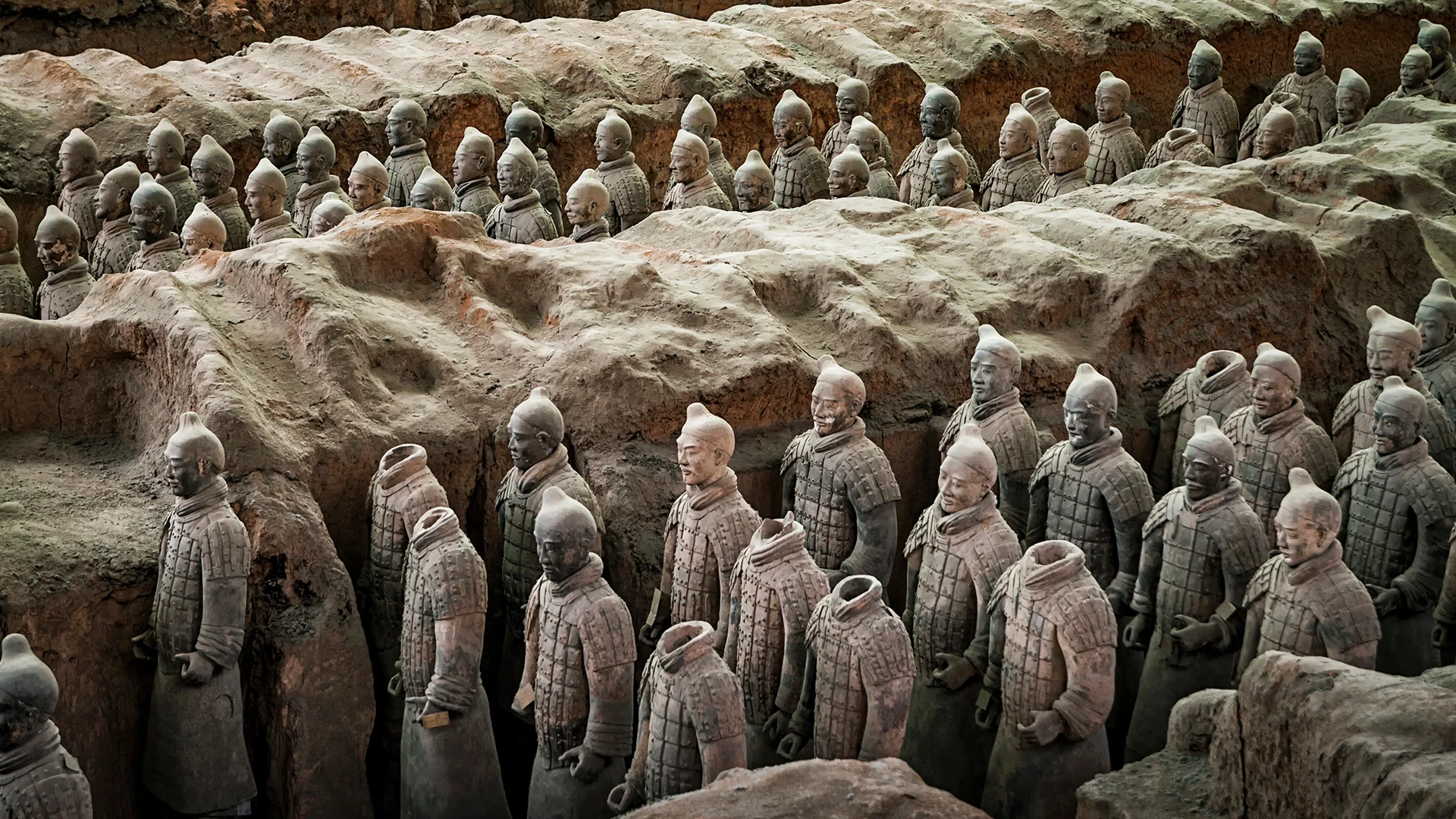
Terracotta Army: Lintong District, Xi'an, around 35 km from central Xi'an.
West Lake: Hangzhou's classic scenic area linked to Song dynasty history and the legend of Bai Suzhen.
Yu Garden: Huangpu District, Shanghai; a Ming-dynasty classical garden near the City God Temple area.

Chengdu Research Base of Giant Panda Breeding: arrive early in the morning when pandas are most active.

Chinese public holidays can dramatically affect prices and queues. If you travel during Spring Festival, May Day, or the first week of October, book transport and attractions as early as possible and expect heavier security checks.
Practical etiquette and local habits
Carry tissue packs; not every public restroom is fully stocked.
Drink bottled or filtered water rather than untreated tap water.
Queue culture is improving, but busy stations still require assertive attention.
When visiting temples, dress respectfully and keep your voice low.
Learn a few useful words: ni hao for hello, xiexie for thank you, and ce suo for restroom.
A little language effort goes far in China. Even in cities with strong tourism infrastructure, a short note in Chinese for your destination can save time and reduce stress.
Frequently Asked Questions
Do I need a visa if I am only staying in China for a few days in 2026?
Maybe not. If your nationality is covered by one of the visa-free countries arrangements or your trip qualifies for the 240-hour transit policy, you may enter without a standard visa, but you must still meet all entry requirements.
How much cash should I carry in China in 2026?
For most short trips, ¥300 to ¥500 is enough as backup cash if your mobile payments and cards are working. In large cities, Alipay and WeChat Pay cover most daily spending, but cash helps for emergencies.
Is the 240-hour transit the same as a tourist visa?
No. The 240-hour transit is a temporary entry permission for eligible passengers traveling onward to a third destination, while a tourist visa is a separate pre-arranged visa category for broader travel plans.
What passport validity should I have before traveling to China?
Six months of passport validity is the safest standard, even if some specific transit cases may be checked differently. Airlines are often stricter than travelers expect, so renewing early reduces risk.
Can I use foreign bank cards in China without local apps?
Sometimes, especially in international hotels, major chain restaurants, and large airports. In daily life, however, foreign visitors travel much more smoothly in 2026 if they set up Alipay or WeChat Pay before arrival.
Is China safe for solo travelers in 2026?
Yes, generally speaking, China is considered safe for solo travelers in major cities and tourist corridors. The main challenges are navigation, digital payments, and peak-season crowds rather than serious personal security threats.
Getting around China efficiently in 2026
The simplest strategy is to use high-speed rail for intercity trips and metro systems for city travel. For most travelers, this is faster, cheaper, and less stressful than relying on domestic flights for short and medium distances.
In 2026, China’s transport network is highly integrated, but the practical rule is simple: book trains early, arrive at stations with extra time, and keep your passport handy for identity checks. This matters especially on routes such as Shanghai to Hangzhou, Beijing to Tianjin, and Guangzhou to Shenzhen, where high-speed rail is often the most efficient option
Disclaimer: This information is provided for reference only and was last updated on . Requirements and regulations may change. Always verify with official sources before making travel plans.