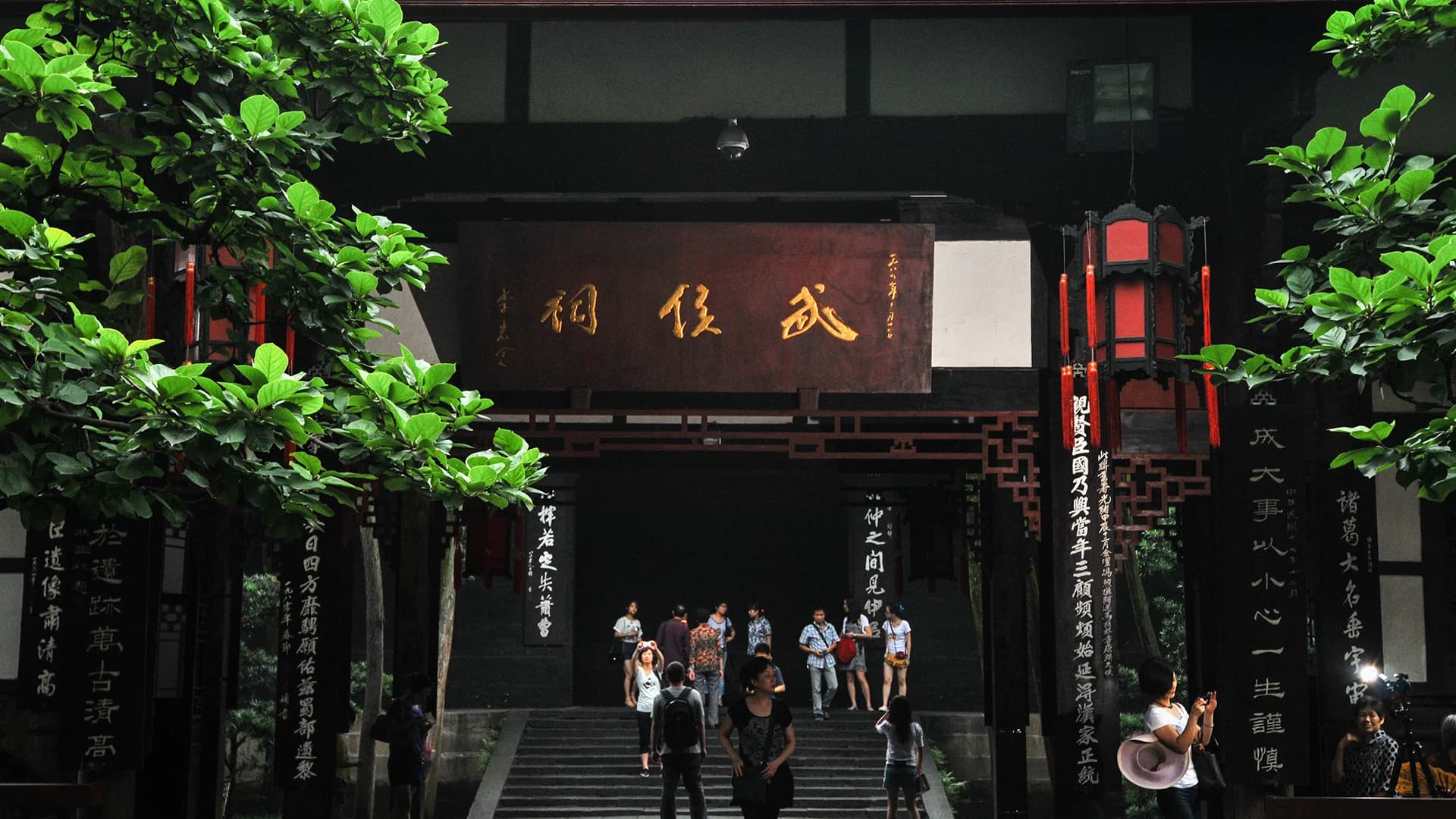
Overview
Wuhou Temple is China's only temple where a ruler and his minister are worshipped together. It's also the most important museum commemorating Zhuge Liang and Liu Bei, representing relics from the Three Kingdoms period, and is hailed as a "Holy Land of the Three Kingdoms." Key attractions include the Liu Bei Hall, the Zhuge Liang Hall (Jingyuan Hall), Liu Bei's true tomb "Huiling," the corridor of civil and military officials, the famous "Three Wonders Stele," and the popular photo spot "Red Wall Alley."
A visit of 2-3 hours is recommended. If combined with a visit to the adjacent Jinli Ancient Street, half a day can be allocated. Chengdu has a mild climate and is suitable for visiting year-round, but the best time is spring and autumn, avoiding the summer heat and winter cold. The early morning opening (around 8:00-9:00 AM) is quiet and less crowded, making it ideal for a visit.
How to Get There
Wuhou Temple is located in the center of Chengdu, making it extremely convenient to reach. The most convenient way is to take Metro Line 3 or 5, get off at Gaoshengqiao Station, exit from Exit D, and walk for about 10 minutes [citation:2]. You can also take a bus; many lines, such as 1, 57, 82, and 334, stop at "Wuhou Temple Station," and the temple is right there.
Recommended itinerary: Enter through the main gate, then visit the Tang Stele, the Han Zhaolie Temple (Liu Bei Hall), and the civil and military officials corridors on both sides. Next, proceed to the Zhuge Liang Hall (Jingyuan Hall), followed by the Sanyi Temple and Huiling Mausoleum. Finally, don't forget to take photos at the famous "Red Wall Alley." After visiting the cultural relics area, you can directly enter the adjacent Jinli Ancient Street through the side gate to sample snacks or buy souvenirs.
What to Expect
The Wuhou Temple scenic area is designed to be very visitor-friendly. Although there are steps between the halls, all are equipped with wheelchair accessible ramps, allowing wheelchairs and strollers to move around easily. Clear multilingual signage is provided throughout the area, and clean, well-marked public restrooms are located along the main roads. An official gift shop (cultural and creative products store) is located at the entrance and near the Zhuge Liang Hall, selling Three Kingdoms-themed souvenirs, books, and postcards. There is also a café within the park for relaxation.
Practical Tips
- Go early, ideally before 10:00, to avoid tour groups and get better photos of the temple courtyards and river viewpoints.
- Use Gaode Maps or Baidu Maps rather than Google Maps in China, especially for finding the correct entrance and local bus stops in Fengjie.
- Pair your visit with Baidi City and Qutang Gorge — most travelers spend 2-3 hours total, not just 30 minutes at the temple alone.
- After visiting the main street, it is recommended to enter directly from the side gate to visit the adjacent Jinli Ancient Street and explore the historical sites.